Cardiologie
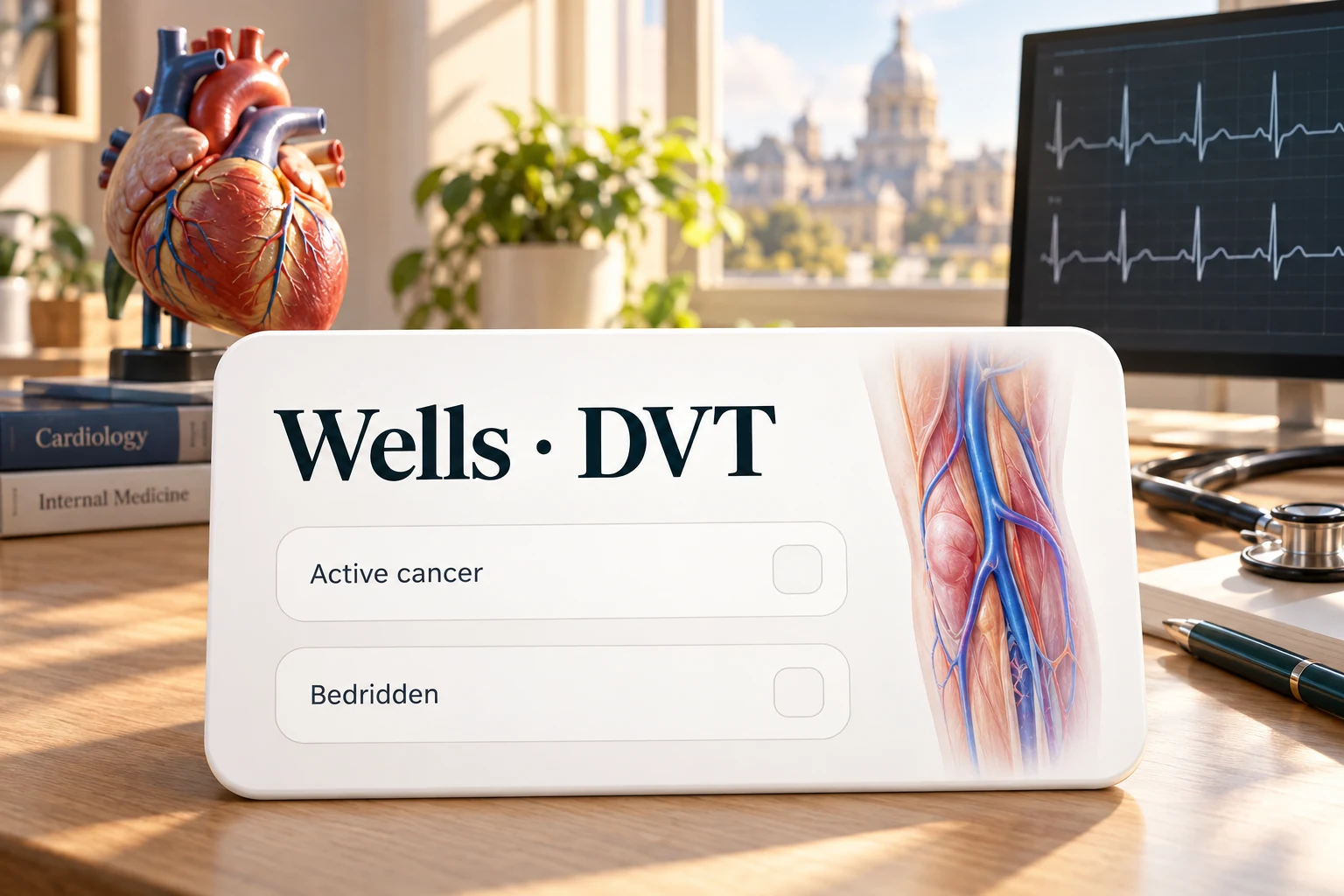
Wells Score for Deep Vein Thrombosis
Klinische waarschijnlijkheid van een diepe veneuze trombose.
Inhoud in het Engels
Wells-score (DVT)-calculator
Uitkomst
0punten
Lage waarschijnlijkheid — eerst D-dimeer
Hoe je hem gebruikt
- 1
Onderzoek het symptomatische been. Kuit ≥3 cm dikker scoort 1. Drukpijn over de diepe venen, pitting oedeem, collaterale venen.
- 2
Overweeg alternatieve diagnoses. Cellulitis, geruptureerde bakercyste, spierhematoom, lymfoedeem — elk even waarschijnlijk = −2 punten.
- 3
Pas de score toe. ≤0: D-dimeer. 1–2: D-dimeer; negatief sluit uit, positief → echo. ≥3: direct echo.
Wanneer je hem gebruikt
Apply to patients presenting with unilateral leg swelling, pain, erythema, or a palpable cord where DVT is a clinical concern. Use before ordering imaging or D-dimer to determine the diagnostic pathway.
- Eenzijdige zwelling/pijn/roodheid van het been
- Standaardpad: Wells + D-dimeer. Lage waarschijnlijkheid + negatief D-dimeer sluit een DVT uit.
- Beenklachten na een operatie
- DVT komt vaak voor na TKP/THP; Wells helpt bepalen of een echo met spoed nodig is.
- Niet bij antistolling
- Het D-dimeer is onbetrouwbaar bij antistolling (het kan vals laag zijn). Ga direct over op duplexonderzoek.
Over de score
The Wells score for deep vein thrombosis (DVT) is the standard clinical probability assessment tool for patients presenting with a swollen, painful, or red leg. It uses nine readily available clinical features to classify patients as low, moderate, or high probability for DVT, directly guiding whether to proceed to compression duplex ultrasound, D-dimer testing, or both. A negative D-dimer in a low-probability patient safely excludes DVT without imaging. The score is endorsed by NICE, ESC, and the American College of Physicians.
Veelgestelde vragen
What Wells DVT score indicates high probability?
A score of ≥3 indicates high probability of DVT. In these patients, proceed directly to compression duplex ultrasound without waiting for D-dimer results. Some guidelines recommend initiating anticoagulation while imaging is pending if the delay exceeds 4 hours.
Can a negative D-dimer rule out DVT?
Yes — but only in patients with a low or moderate probability Wells DVT score (≤2). In high-probability patients (score ≥3), D-dimer should not be used to exclude DVT, as a negative result does not have sufficient negative predictive value in this population.