Cardiologie
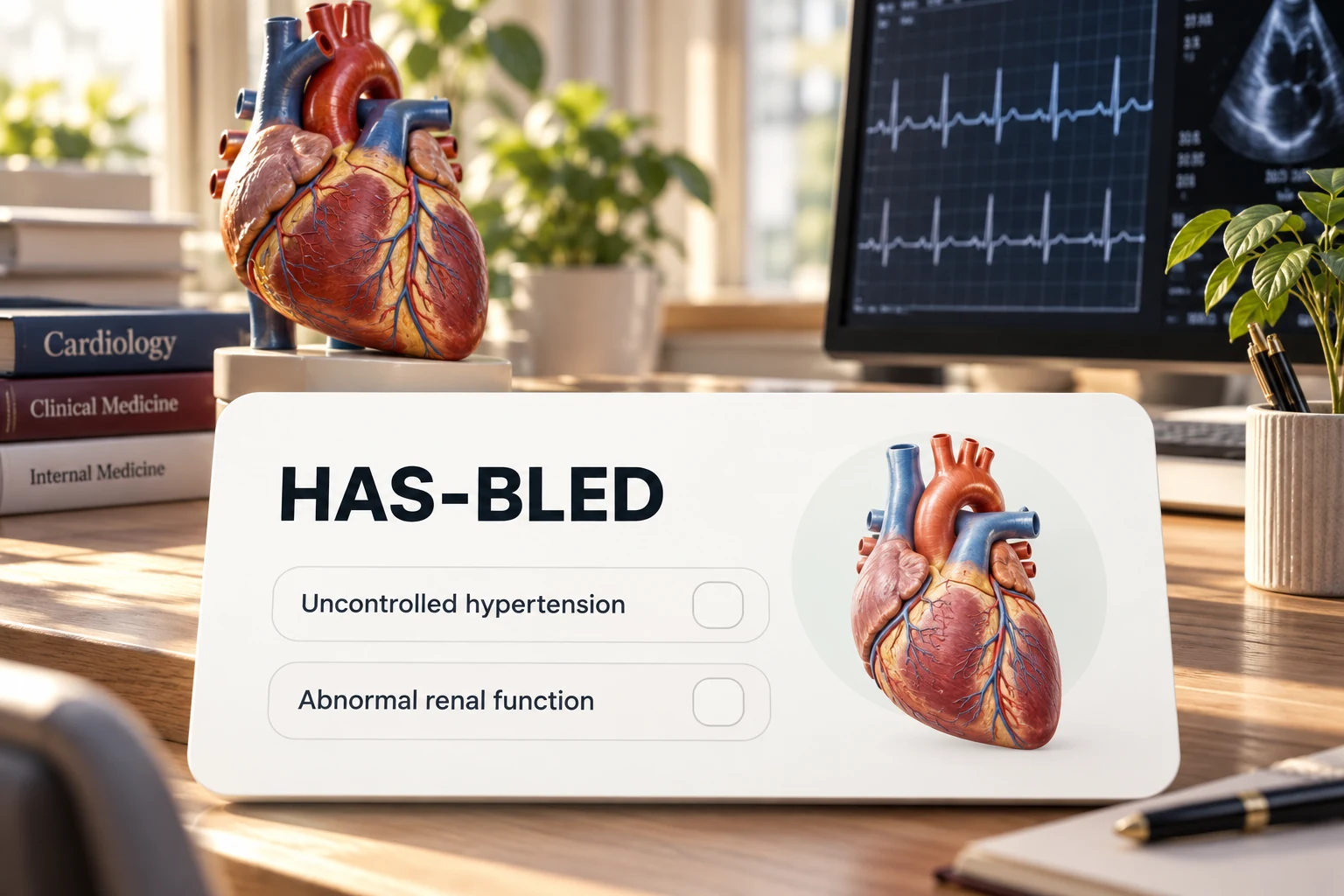
HAS-BLED Bleeding Risk Score
Bloedingsrisico tijdens antistolling bij AF.
Inhoud in het Engels
HAS-BLED-calculator
Uitkomst
0punten
Laag bloedingsrisico (~1–2%/jaar)
Hoe je hem gebruikt
- 1
Scoor elk H-A-S-B-L-E-D-criterium. Hypertensie, nier-/leverfunctiestoornis, beroerte, bloeding, labiele INR, oudere leeftijd, geneesmiddelen/alcohol — elk telt voor 1.
- 2
Benoem beïnvloedbare factoren. Hypertensie, labiele INR, gebruik van NSAID’s/trombocytenaggregatieremmers en alcohol kunnen worden aangepakt om het bloedingsrisico te verlagen.
- 3
Interpreteer in context. Een hoge HAS-BLED mag niet automatisch van antistolling weerhouden — het risico op een beroerte weegt meestal zwaarder. Gebruik de score om corrigeerbare risico’s te signaleren.
Wanneer je hem gebruikt
Assess in all AF patients being considered for or already receiving anticoagulation. Use in parallel with CHA₂DS₂-VASc to balance stroke prevention against bleeding risk. Most useful for flagging modifiable bleeding risks that can be corrected before or during anticoagulation.
- Starten met antistolling bij AF
- Samen met CHA₂DS₂-VASc. Een hoog bloedingsrisico (≥3) vraagt om optimalisatie van beïnvloedbare factoren, niet per se om het onthouden van antistolling.
- Herbeoordeling van antistolling
- Jaarlijkse herbeoordeling. De score kan veranderen door leeftijd, nieuwe medicatie of achteruitgang van de nierfunctie.
- Geen vetorecht
- HAS-BLED ≥3 signaleert risico, maar weegt zelden op tegen een duidelijk voordeel van antistolling bij AF met een hoog risico op een beroerte.
Over de score
HAS-BLED is the most widely validated bleeding risk score for patients with atrial fibrillation who are receiving or being considered for oral anticoagulation. It was developed to help clinicians identify and address modifiable bleeding risk factors rather than to withhold anticoagulation. A high HAS-BLED score should prompt correction of reversible risks (uncontrolled hypertension, labile INR, concurrent antiplatelet/NSAID use, alcohol excess) and more frequent clinical review — not automatic exclusion from anticoagulation. Used alongside CHA₂DS₂-VASc in the ESC AF management pathway.
Veelgestelde vragen
What HAS-BLED score is considered high risk?
A score of ≥3 is classified as high bleeding risk by ESC guidelines. However, this should prompt correction of modifiable bleeding risk factors and more frequent monitoring — not automatic discontinuation or withholding of anticoagulation.
Can I use HAS-BLED to decide whether to start anticoagulation?
HAS-BLED is designed to identify modifiable bleeding risks, not to override the anticoagulation decision. Pair it with CHA₂DS₂-VASc — for most patients with score ≥2 on CHA₂DS₂-VASc, the net clinical benefit of anticoagulation outweighs the bleeding risk even with a high HAS-BLED score.