Cardiologie
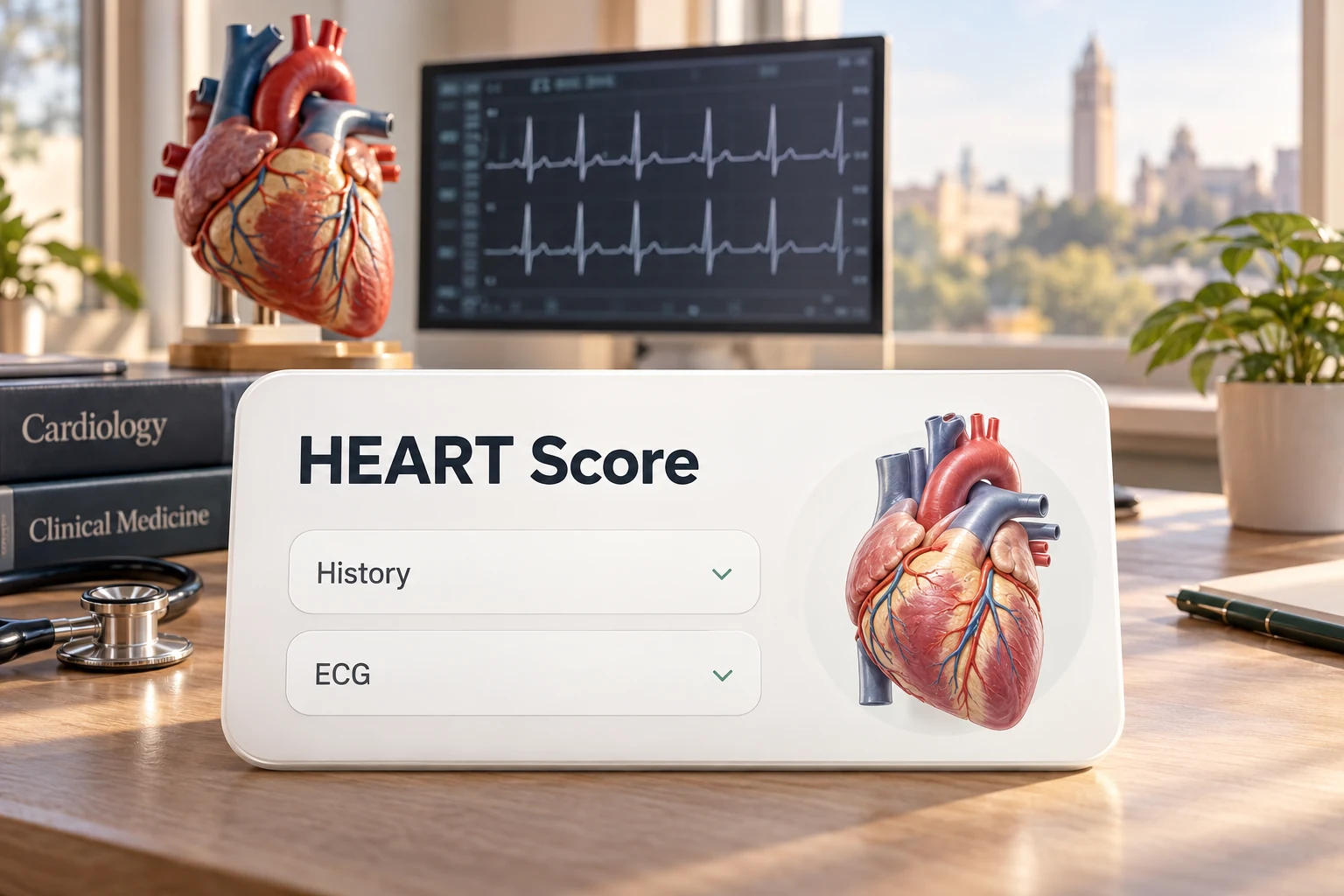
HEART Score for Chest Pain
Risque de MACE à 6 semaines en cas de douleur thoracique.
Contenu en anglais
Calculateur Score HEART
Résultat
3points
Faible — MACE < 2%, sortie précoce sûre
Comment l’utiliser
- 1
Évaluer l’anamnèse. Très suspecte : oppression, irradiation, à l’effort, soulagée par les dérivés nitrés. Peu suspecte : pleurale, bien localisée.
- 2
Analyser l’ECG. Normal=0, non spécifique (HVG, BBG, troubles de repolarisation)=1, déviation significative du ST=2.
- 3
Troponine rapportée à la LSN. Utiliser la limite supérieure de référence au 99e percentile du laboratoire. hsTnI/hsTnT ×1–3=1pt, >3×=2pt.
Quand l’utiliser
Apply to all patients presenting to the emergency department with acute chest pain where ACS must be excluded. Particularly useful for the large proportion of chest pain presentations that are ultimately non-cardiac.
- Tri de la douleur thoracique aiguë aux urgences
- Un score ≤3 permet la sortie sans autre exploration.
- Protocoles troponine 0/3h
- À associer à une hsTn à 0h et 3h pour une exclusion rapide (algorithme ESC 2020).
- Pas pour le STEMI
- Le STEMI va directement en salle de coronarographie quel que soit le score HEART.
À propos du score
The HEART score is a validated 5-variable risk stratification tool for patients presenting to the emergency department with chest pain of possible cardiac origin. Each of the five components — History, ECG, Age, Risk factors, and Troponin — is scored 0, 1, or 2, giving a maximum of 10 points. Low-risk patients (HEART score 0–3) have a very low 6-week MACE rate (<2%) and can be safely discharged from the emergency department without admission, significantly reducing unnecessary hospitalisation. High-risk patients (score 7–10) require urgent cardiological referral and admission.
Questions fréquentes
What HEART score is safe for discharge?
A HEART score of 0–3 is classified as low risk, with a 6-week major adverse cardiac event (MACE) rate below 2%. These patients can be safely discharged from the emergency department with outpatient cardiology follow-up, provided their initial and serial troponins are negative.
What does HEART stand for in the HEART score?
HEART is an acronym for the five variables: History (chest pain characteristics), ECG findings, Age, Risk factors for coronary artery disease, and Troponin level. Each component is scored 0–2, giving a maximum total of 10.