Cardiologie
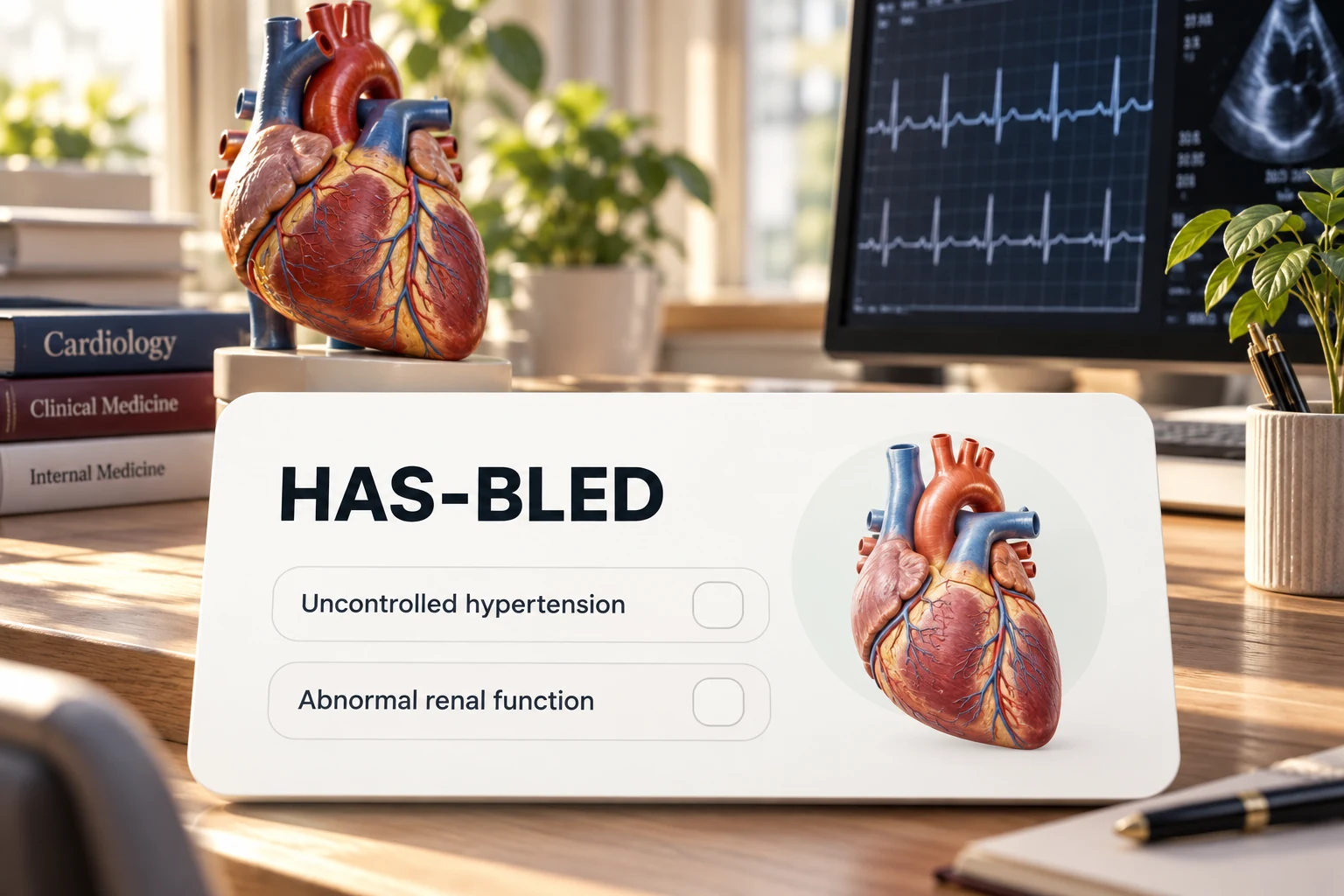
HAS-BLED Bleeding Risk Score
Risque hémorragique sous anticoagulant dans la FA.
Contenu en anglais
Calculateur HAS-BLED
Résultat
0points
Risque hémorragique faible (~1–2%/an)
Comment l’utiliser
- 1
Coter chaque critère H-A-S-B-L-E-D. Hypertension, dysfonction rénale/hépatique, antécédent d’AVC, saignement, INR instable, âge, médicaments/alcool — chacun vaut 1.
- 2
Repérer les facteurs modifiables. HTA, INR instable, AINS/antiagrégants et alcool peuvent être corrigés pour réduire le risque hémorragique.
- 3
Interpréter en contexte. Un HAS-BLED élevé ne doit pas faire renoncer automatiquement à l’anticoagulation — le risque d’AVC l’emporte généralement. À utiliser pour repérer les risques corrigibles.
Quand l’utiliser
Assess in all AF patients being considered for or already receiving anticoagulation. Use in parallel with CHA₂DS₂-VASc to balance stroke prevention against bleeding risk. Most useful for flagging modifiable bleeding risks that can be corrected before or during anticoagulation.
- Mise en route d’une anticoagulation dans la FA
- Associé au CHA₂DS₂-VASc. Un risque hémorragique élevé (≥3) impose d’optimiser les facteurs modifiables, pas nécessairement de renoncer à l’anticoagulation.
- Réévaluation de l’anticoagulation
- Réévaluation annuelle. Le score peut évoluer avec l’âge, de nouveaux médicaments ou une dégradation de la fonction rénale.
- Pas un outil de veto
- Un HAS-BLED ≥3 signale un risque mais l’emporte rarement sur un bénéfice clair de l’anticoagulation dans la FA à haut risque d’AVC.
À propos du score
HAS-BLED is the most widely validated bleeding risk score for patients with atrial fibrillation who are receiving or being considered for oral anticoagulation. It was developed to help clinicians identify and address modifiable bleeding risk factors rather than to withhold anticoagulation. A high HAS-BLED score should prompt correction of reversible risks (uncontrolled hypertension, labile INR, concurrent antiplatelet/NSAID use, alcohol excess) and more frequent clinical review — not automatic exclusion from anticoagulation. Used alongside CHA₂DS₂-VASc in the ESC AF management pathway.
Questions fréquentes
What HAS-BLED score is considered high risk?
A score of ≥3 is classified as high bleeding risk by ESC guidelines. However, this should prompt correction of modifiable bleeding risk factors and more frequent monitoring — not automatic discontinuation or withholding of anticoagulation.
Can I use HAS-BLED to decide whether to start anticoagulation?
HAS-BLED is designed to identify modifiable bleeding risks, not to override the anticoagulation decision. Pair it with CHA₂DS₂-VASc — for most patients with score ≥2 on CHA₂DS₂-VASc, the net clinical benefit of anticoagulation outweighs the bleeding risk even with a high HAS-BLED score.