Cardiología
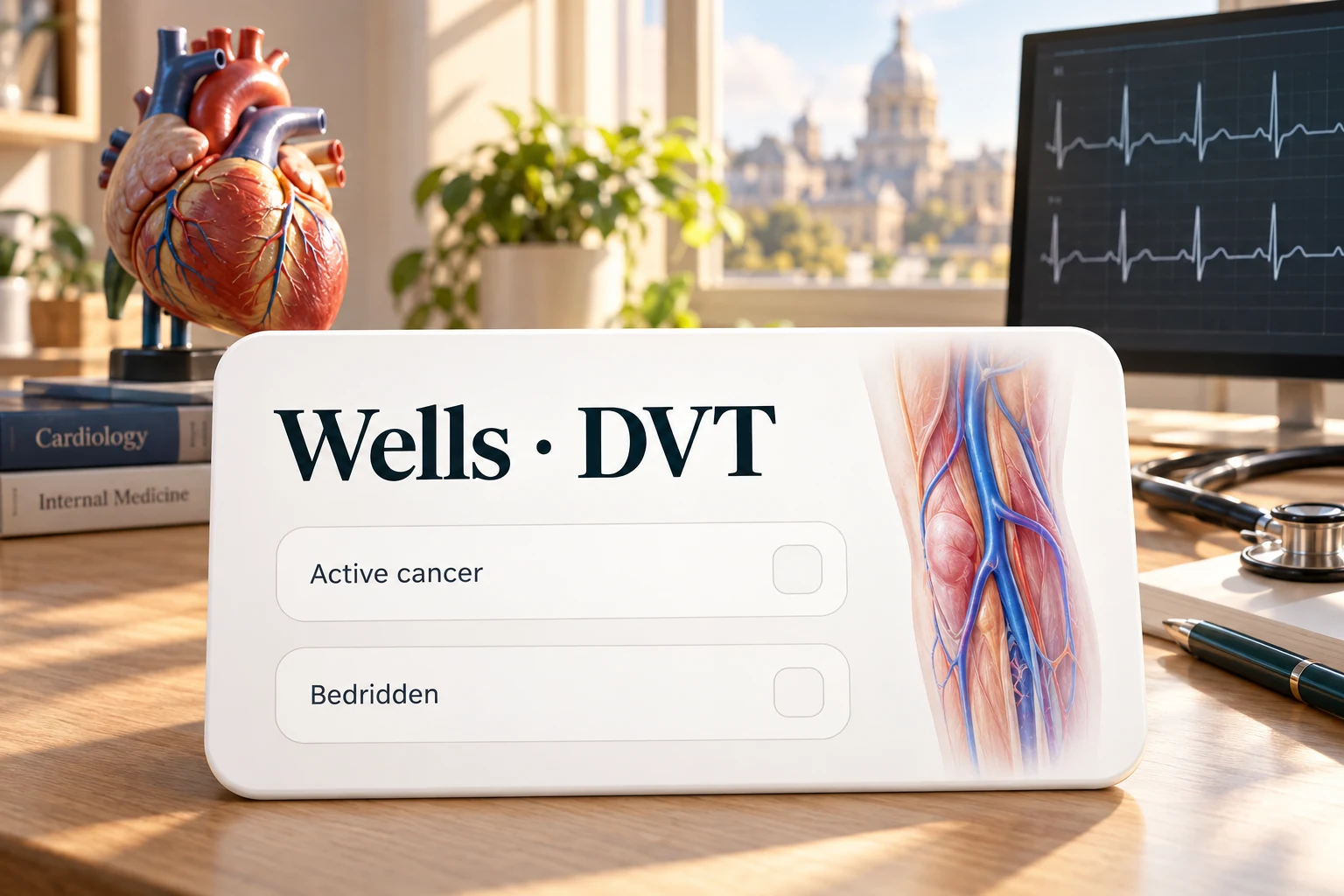
Wells Score for Deep Vein Thrombosis
Probabilidad pretest de trombosis venosa profunda.
Contenido en inglés
Calculadora Escala de Wells (TVP)
Resultado
0puntos
Probabilidad baja — dímero D primero
Cómo usarla
- 1
Explorar la pierna sintomática. Pantorrilla ≥3 cm mayor suma 1. Dolor sobre las venas profundas, edema con fóvea, venas colaterales.
- 2
Considerar diagnósticos alternativos. Celulitis, quiste de Baker roto, hematoma muscular, linfedema — cada uno igual de probable = −2 puntos.
- 3
Aplicar la puntuación. ≤0: dímero D. 1–2: dímero D; si es negativo descarta; si es positivo → ecografía. ≥3: ecografía directamente.
Cuándo usarla
Apply to patients presenting with unilateral leg swelling, pain, erythema, or a palpable cord where DVT is a clinical concern. Use before ordering imaging or D-dimer to determine the diagnostic pathway.
- Hinchazón/dolor/enrojecimiento unilateral de la pierna
- Vía estándar: Wells + dímero D. Probabilidad baja + dímero D negativo descarta la TVP.
- Síntomas en la pierna tras una cirugía
- TVP frecuente tras prótesis de rodilla/cadera; el Wells orienta si la ecografía es urgente.
- No si está anticoagulado
- El dímero D no es fiable con anticoagulación (puede estar falsamente bajo). Pasar directamente a la ecografía dúplex.
Sobre la escala
The Wells score for deep vein thrombosis (DVT) is the standard clinical probability assessment tool for patients presenting with a swollen, painful, or red leg. It uses nine readily available clinical features to classify patients as low, moderate, or high probability for DVT, directly guiding whether to proceed to compression duplex ultrasound, D-dimer testing, or both. A negative D-dimer in a low-probability patient safely excludes DVT without imaging. The score is endorsed by NICE, ESC, and the American College of Physicians.
Preguntas frecuentes
What Wells DVT score indicates high probability?
A score of ≥3 indicates high probability of DVT. In these patients, proceed directly to compression duplex ultrasound without waiting for D-dimer results. Some guidelines recommend initiating anticoagulation while imaging is pending if the delay exceeds 4 hours.
Can a negative D-dimer rule out DVT?
Yes — but only in patients with a low or moderate probability Wells DVT score (≤2). In high-probability patients (score ≥3), D-dimer should not be used to exclude DVT, as a negative result does not have sufficient negative predictive value in this population.