Cardiología
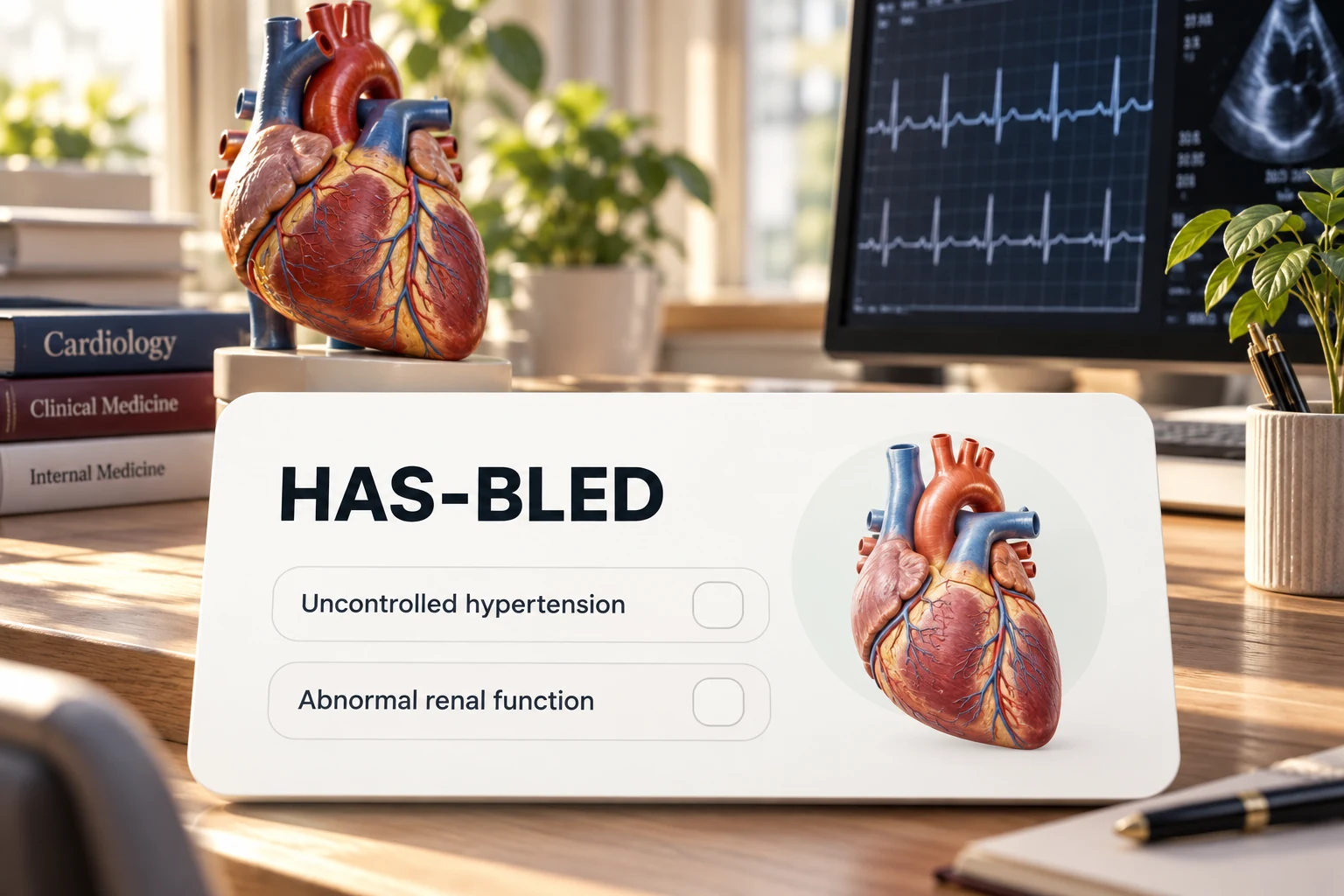
HAS-BLED Bleeding Risk Score
Riesgo hemorrágico con anticoagulación en la FA.
Contenido en inglés
Calculadora HAS-BLED
Resultado
0puntos
Riesgo hemorrágico bajo (~1–2%/año)
Cómo usarla
- 1
Puntuar cada criterio H-A-S-B-L-E-D. Hipertensión, disfunción renal/hepática, antecedente de ictus, hemorragia, INR lábil, edad avanzada, fármacos/alcohol — 1 punto cada uno.
- 2
Identificar factores modificables. HTA, INR lábil, AINE/antiagregantes y alcohol pueden corregirse para reducir el riesgo hemorrágico.
- 3
Interpretar en contexto. Un HAS-BLED alto no debe impedir automáticamente la anticoagulación — el riesgo de ictus suele ser mayor. Usar para señalar riesgos corregibles.
Cuándo usarla
Assess in all AF patients being considered for or already receiving anticoagulation. Use in parallel with CHA₂DS₂-VASc to balance stroke prevention against bleeding risk. Most useful for flagging modifiable bleeding risks that can be corrected before or during anticoagulation.
- Inicio de la anticoagulación en la FA
- Junto con el CHA₂DS₂-VASc. Un riesgo hemorrágico alto (≥3) obliga a optimizar los factores modificables, no necesariamente a renunciar a la anticoagulación.
- Revisión de la anticoagulación
- Reevaluación anual. La puntuación puede cambiar con la edad, nuevos fármacos o el deterioro de la función renal.
- No es una herramienta de veto
- Un HAS-BLED ≥3 señala riesgo, pero rara vez supera un beneficio claro de la anticoagulación en la FA con alto riesgo de ictus.
Sobre la escala
HAS-BLED is the most widely validated bleeding risk score for patients with atrial fibrillation who are receiving or being considered for oral anticoagulation. It was developed to help clinicians identify and address modifiable bleeding risk factors rather than to withhold anticoagulation. A high HAS-BLED score should prompt correction of reversible risks (uncontrolled hypertension, labile INR, concurrent antiplatelet/NSAID use, alcohol excess) and more frequent clinical review — not automatic exclusion from anticoagulation. Used alongside CHA₂DS₂-VASc in the ESC AF management pathway.
Preguntas frecuentes
What HAS-BLED score is considered high risk?
A score of ≥3 is classified as high bleeding risk by ESC guidelines. However, this should prompt correction of modifiable bleeding risk factors and more frequent monitoring — not automatic discontinuation or withholding of anticoagulation.
Can I use HAS-BLED to decide whether to start anticoagulation?
HAS-BLED is designed to identify modifiable bleeding risks, not to override the anticoagulation decision. Pair it with CHA₂DS₂-VASc — for most patients with score ≥2 on CHA₂DS₂-VASc, the net clinical benefit of anticoagulation outweighs the bleeding risk even with a high HAS-BLED score.