Gastroenterologie und Hepatologie
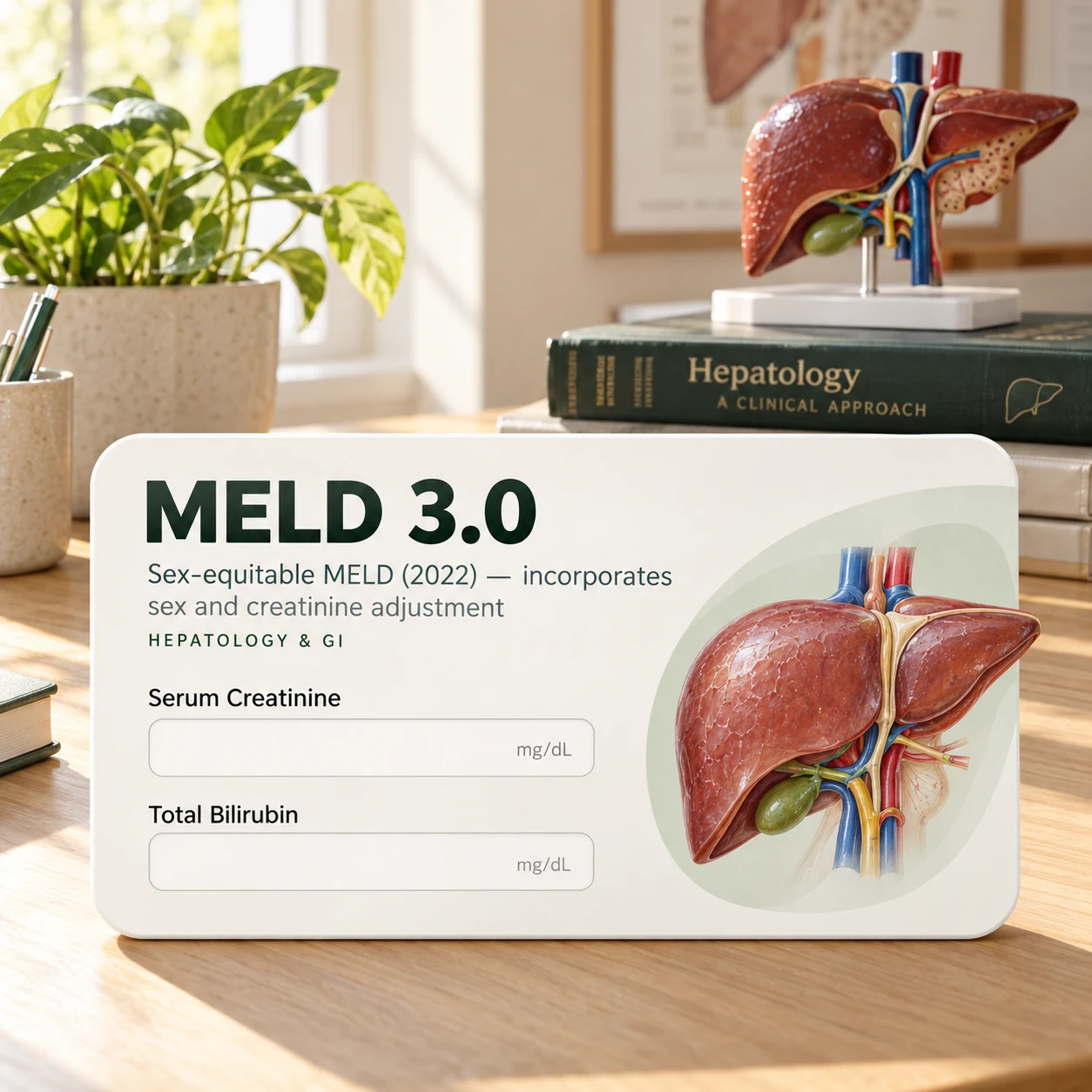
Model for End-Stage Liver Disease Score
Priorität für eine Lebertransplantation — natriumkorrigierter MELD.
Inhalt auf Englisch
MELD-Na-Score-Rechner
Ergebnis
6Punkte
Niedrige Priorität — 90-Tage-Mortalität ~2%
So wendest du ihn an
- 1
Laborwerte innerhalb von 24h vor der Listung. UNOS begrenzt das Kreatinin auf 4.0 mg/dL und wertet 2+ Dialysen pro Woche als 4.0.
- 2
Der Bereich Na 125–137 ist entscheidend. Natrium < 125: 125 verwenden. > 137: 137 verwenden (kein Effekt).
- 3
MELD-Na-Formel. MELD-Na = MELD + 1.32(137−Na) − 0.033×MELD×(137−Na).
Wann du ihn einsetzt
Use in adults with known or suspected chronic liver disease, cirrhosis, or acute liver failure to estimate prognosis and prioritise liver transplantation. Also guides intensity of monitoring and ICU admission decisions.
- Allokation von Lebertransplantaten
- UNOS verwendet MELD-Na ≥15 für Organangebote von Verstorbenen (Priorität vor Lebendspende).
- Prognose der Leberzirrhose
- MELD-Na < 10: konservative Therapie. 10–14: abwartendes Vorgehen. ≥15: Listung besprechen.
- Beurteilung vor TIPS
- MELD > 18 nach TIPS: schlechtes Überleben. Palliativversorgung versus Transplantation erwägen.
Über den Score
The Model for End-Stage Liver Disease (MELD) score is a validated prognostic scoring system for patients with chronic liver disease, liver cirrhosis, and acute liver failure. Originally developed to predict 90-day mortality following elective TIPS (transjugular intrahepatic portosystemic shunt) procedures, it became the primary tool for organ allocation in liver transplantation in the United States (UNOS/OPTN) from 2002 and is now used by European transplant networks. MELD uses three objective laboratory values — INR, serum bilirubin, and serum creatinine — to generate a score predicting short-term mortality risk. MELD-Na (incorporating serum sodium) has improved predictive accuracy and is now preferred by many centres.
Häufige Fragen
What is a high MELD score?
A MELD score ≥20 indicates substantial liver disease severity with 90-day mortality risk of 20–30%. Scores ≥30 carry >50% 90-day mortality and typically require urgent liver transplant evaluation. Scores ≥40 are associated with >70% short-term mortality without transplantation.
What is the difference between MELD and Child-Pugh score?
MELD uses three objective laboratory values (INR, bilirubin, creatinine) and is the current standard for transplant prioritisation. Child-Pugh includes two subjective components (ascites severity and encephalopathy grade), making it less reproducible. MELD has replaced Child-Pugh for transplant allocation but Child-Pugh remains useful for assessing surgical risk and cirrhosis staging.