Gastroenterologie und Hepatologie
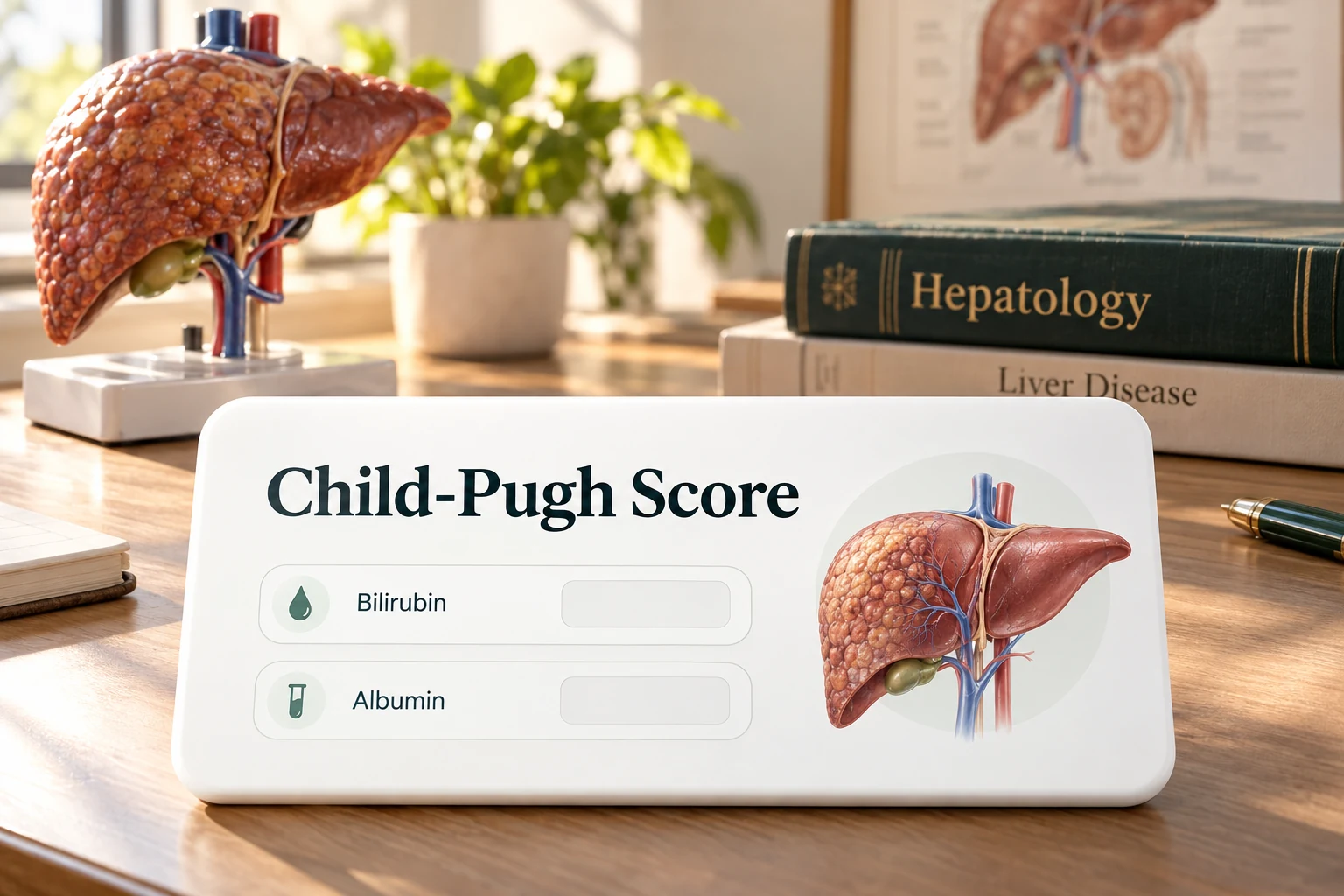
Child-Pugh Score for Cirrhosis
Schweregrad der Leberzirrhose — Klassifikation A, B, C.
Inhalt auf Englisch
Child-Pugh-Score-Rechner
Ergebnis
Klasse A (5)
Überleben: 1 Jahr ~95%, 2 Jahre ~90%
So wendest du ihn an
- 1
5 Domänen. Bilirubin, Albumin, INR, Aszites, Enzephalopathie — jeweils mit 1–3 bewertet.
- 2
Klasse A (5–6). Gute Funktion. Klasse B (7–9): mäßig. Klasse C (10–15): schlecht.
- 3
Bilirubingrenzen für die PBC verwenden. Bei primär biliärer Cholangitis gelten andere Bilirubingrenzen.
Wann du ihn einsetzt
Use in patients with known or suspected liver cirrhosis for staging, prognosis, surgical risk assessment, and guiding management decisions. Class C cirrhosis typically warrants transplant evaluation.
- Operationsrisiko bei Leberzirrhose
- Child-Pugh A: Mortalität ~10%. B: ~30%. C: ~80% bei großen abdominellen Eingriffen.
- Arzneimitteldosierung
- Viele hepatisch metabolisierte Arzneimittel: halbe Dosis bei Child-Pugh B; bei C vermeiden.
- Screening auf HCC
- Child-Pugh A/B: alle 6 Monate Sonografie + AFP. Child-Pugh C ohne Transplantationslistung: begrenzter Nutzen.
Über den Score
The Child-Pugh score (originally the Child-Turcotte-Pugh score) is a widely used clinical grading system for the severity of chronic liver disease and cirrhosis. It combines five variables — serum bilirubin, serum albumin, prothrombin time/INR, ascites severity, and hepatic encephalopathy grade — to classify patients into three categories: Class A (well-compensated), Class B (significant functional compromise), and Class C (decompensated cirrhosis). Despite being partially superseded by MELD for transplant prioritisation, Child-Pugh remains valuable for assessing surgical risk, prognosis in non-transplant settings, and as a simple bedside classification system.
Häufige Fragen
What is Child-Pugh Class C?
Child-Pugh Class C (score 10–15) represents decompensated cirrhosis with an estimated 1-year survival of approximately 45% and 2-year survival of 35% without liver transplantation. It indicates significant hepatic decompensation and typically warrants transplant evaluation.
What is the difference between Child-Pugh and MELD score?
Child-Pugh uses five variables (two objective laboratory values and three clinical assessments) and classifies patients into classes A, B, C. MELD uses three purely objective laboratory values (INR, bilirubin, creatinine) and generates a continuous numeric score. MELD is now preferred for transplant prioritisation due to better predictive accuracy and reproducibility, but Child-Pugh is still widely used for surgical risk stratification and simple clinical staging.