Prognia
Back to Guidelines
Veterans Health Administration / Department of DefensePhysical Medicine and Rehabilitation2025advanced

Rehabilitation of Lower Limb Amputation

Published by Department of Veterans Affairs and Department of Defense · GRADE

26Recommendations
201References
15Tables
1Figures

Summary

AI-generated

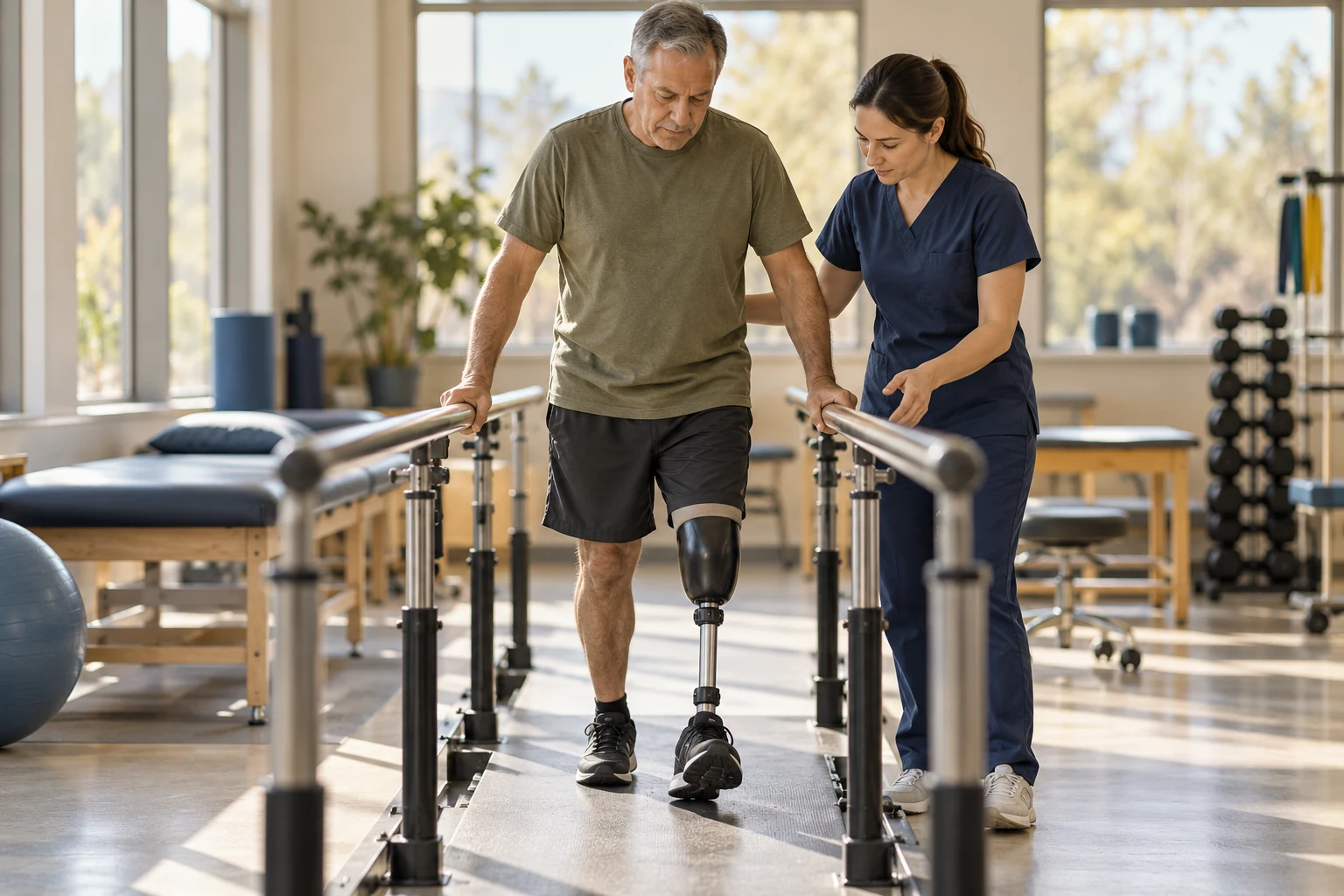
This clinical practice guideline provides an evidence-based framework for evaluating and managing care for adult patients who have experienced lower limb amputation. It emphasizes a patient-centered, multidisciplinary approach to optimize functional independence, health outcomes, and quality of life.

lower limb amputationprosthetic kneemicroprocessor kneeVA/DODphysical medicine and rehabilitationrehabilitation guidelinesamputation care teambehavioral health

Key Takeaways

  • 1
    Engage a multidisciplinary amputation care team (ACT).
  • 2
    Provide post-operative amputation care in an inpatient rehabilitation facility over other settings.
  • 3
    Prescribe microprocessor knee units over non-microprocessor knee units for prosthetic ambulators.
  • 4
    Provide routine behavioral health and psychosocial assessments.
  • 5
    Use rigid or semi-rigid residual limb dressings post-transtibial amputation to promote healing.
  • 6
    Offer peer support by a trained peer as a component of rehabilitation.
  • 7
    Use patient-reported and performance-based measures to assess function.

What's New in This Version

Added 12 new recommendations, reviewed and replaced 4 recommendations, reviewed and amended 3 recommendations, carried over 1 recommendation not changed, and carried over 4 recommendations amended from the 2017 VA/DOD LLA CPG. The methodology was updated to reflect a more rigorous application of the GRADE framework.

Key Recommendations

IX. Recommendations

  • 1

    There is insufficient evidence to recommend one surgical amputation procedure over another.

    Neither for nor againstEvidence: Very lowSurgical
  • 2

    For patients with transfemoral amputation who meet eligibility criteria, we suggest osseointegration as an option to improve prosthesis use.

    Weak forEvidence: Very lowSurgical/Prosthetic
  • 3

    There is insufficient evidence to recommend for or against targeted muscle reinnervation or other peripheral nerve surgical management for phantom limb pain.

    Neither for nor againstEvidence: Very lowSurgical
  • 4

    We suggest intraoperative placement of a perineural catheter for the post-operative delivery of local anesthetic to reduce pain following amputation surgery.

    Weak forEvidence: LowSurgical/Pharmacologic
  • 5

    Post-transtibial amputation, we suggest application of a rigid or semi-rigid residual limb dressing to promote healing and early prosthesis use as soon as feasible.

    Weak forEvidence: Very lowManagement/Rehabilitation
  • 6

    We suggest providing post-operative amputation care in an inpatient rehabilitation facility (IRF) over other settings (e.g., skilled nursing facility (SNF) or home care).

    Weak forEvidence: LowCare Setting
  • 7

    We suggest assessment and treatment to improve behavioral health and psychosocial functioning.

    Weak forEvidence: LowAssessment/Treatment
  • 8

    We suggest peer support by a trained peer as a component of rehabilitation to improve psychosocial function.

    Weak forEvidence: Very lowRehabilitation/Support
  • 9

    We suggest cognitive assessment to inform rehabilitation goals and prosthetic candidacy.

    Weak forEvidence: Very lowAssessment
  • 10

    We suggest the care team provides patient education throughout amputation rehabilitation.

    Weak forEvidence: Very lowEducation
  • 11

    We suggest mirror therapy, alone or in combination with other therapies, to improve pain, function and quality of life for individuals with phantom limb pain.

    Weak forEvidence: Very lowRehabilitation/Therapy
  • 12

    We suggest an individualized and skilled rehabilitation program with exercise and gait training to improve functional status, walking ability, and quality of life.

    Weak forEvidence: Very lowRehabilitation
  • 13

    We suggest using patient-identified sex to inform individualized rehabilitation plans.

    Weak forEvidence: Very lowManagement
  • 14

    We suggest screening for factors associated with rehabilitation outcomes following acquired limb loss, (e.g., smoking, comorbid injuries or illnesses, psychosocial characteristics and physical function).

    Weak forEvidence: LowAssessment
  • 15

    For community ambulators, there is insufficient evidence to recommend any specific transfemoral socket design.

    Neither for nor againstEvidence: Very lowProsthetic
  • 16

    For community ambulators, there is insufficient evidence to recommend for or against ischial containment or sub-ischial socket designs.

    Neither for nor againstEvidence: Very lowProsthetic
  • 17

    For prosthetic ambulators, we suggest prescribing microprocessor knee units over non-microprocessor knee units for reducing falls, optimizing functional mobility, and improving patient satisfaction.

    Weak forEvidence: Very lowProsthetic
  • 18

    For prosthetic ambulators, there is insufficient evidence to prescribe any specific energy storing and return (ESAR) or microprocessor foot and ankle component over another.

    Neither for nor againstEvidence: Very lowProsthetic
  • 19

    For prosthetic ambulators, we suggest energy storing and return (ESAR) or microprocessor-controlled foot and ankle components over solid ankle cushioned heel (SACH) feet to improve ambulation and patient satisfaction.

    Weak forEvidence: Very lowProsthetic
  • 20

    We suggest using patient-reported and performance-based measures with acceptable psychometric properties to assess function.

    Weak forEvidence: Very lowAssessment
  • 21

    There is insufficient evidence to recommend for or against neurostimulation or neuroablation interventions for the management of phantom limb pain or residual limb pain.

    Neither for nor againstEvidence: Very lowTherapy/Surgical
  • 22

    We suggest perineural catheter delivered anesthetic for the treatment of chronic severe phantom limb pain with functional impairment.

    Weak forEvidence: LowPharmacologic
  • 23

    There is insufficient evidence to recommend for or against any systemic pharmacologic intervention for the management of phantom limb pain.

    Neither for nor againstEvidence: Very lowPharmacologic
  • 24

    For prosthesis users with hyperhidrosis, there is insufficient evidence to recommend for or against Botulinum toxin treatment to reduce sweat production, improve prosthetic function, reduce pain, and improve quality of life.

    Neither for nor againstEvidence: Very lowPharmacologic
  • 25

    There was insufficient evidence to recommend for or against strategies to prevent re-amputation of the ipsilateral limb or amputation of the contralateral limb.

    Neither for nor againstEvidence: LowPrevention
  • 26

    There is insufficient evidence to recommend for or against any specific intervention to improve intimacy and sexual health.

    Neither for nor againstEvidence: Very lowIntervention

Scope & Objectives

Clinical Topic

Lower Limb Amputation Rehabilitation

Objectives

To provide an evidence-based framework for evaluating and managing care for adult patients who have experienced lower limb amputation, toward improving clinical outcomes.

Target Patient Population

Adult patients, 18 years or older, who have experienced lower limb amputation

Target Providers

VA, DOD, and community providersPhysiatristsPhysical TherapistsOccupational TherapistsCertified ProsthetistsSocial WorkersRehabilitation PsychologistsNurses

Patient Criteria & Setting

Therapeutic Area

Rehabilitation

Guideline Scope

AssessmentManagementRehabilitationPost-operative Care

Inclusion Criteria

  • Adults ages 18 years or older
  • Patients with a lower extremity amputation (unilateral or bilateral and at any level)
  • Treated in any clinical setting

Exclusion Criteria

  • Children or adolescents with lower limb amputation
  • Individuals with multiple limb loss

Care Settings

Inpatient Rehabilitation Facility (IRF)Skilled Nursing Facility (SNF)Home CareOutpatient CarePrimary Care

Special Populations

VeteransActive duty service membersGuard and Reserve service membersAdult beneficiariesPatients with diabetes mellitusPatients with peripheral arterial disease

Evidence Grading

System: GRADE

Evidence Distribution

Recommendation from the previous CPG that has been carried forward to the updated CPG where the evidence has been reviewed and a minor amendment has been made.Reviewed, Amended
Recommendation from the previous CPG that has been removed based on review of the evidence.Reviewed, Deleted
New recommendation following review of the evidence.Reviewed, New-added
Recommendation from the previous CPG that has been carried forward to the updated CPG where the evidence has not been reviewed and a minor amendment has been made.Not reviewed, Amended
Recommendation from the previous CPG that has been removed because it was deemed out of scope for the updated CPG.Not reviewed, Deleted
Recommendation from previous CPG that has been carried forward to the updated CPG where the evidence has been reviewed but the recommendation is not changed.Reviewed, Not changed
Recommendation from previous CPG that has been carried over to the updated CPG that has been changed following review of the evidence.Reviewed, New-replaced
Recommendation from previous CPG that has been carried forward to the updated CPG, but for which the evidence has not been reviewed.Not reviewed, Not changed

Evidence Levels

LowLow confidence in the quality of the evidence.
HighHigh confidence in the quality of the evidence.
ModerateModerate confidence in the quality of the evidence.
Very lowVery low confidence in the quality of the evidence.

Recommendation Strength

Weak forWe suggest...
Strong forWe recommend...
Weak againstWe suggest against...
Strong againstWe recommend against...
Neither for nor againstThere is insufficient evidence to recommend for or against...

Safety & Contraindications

Contraindications

  • High-impact sports and water activities (for patients with osseointegrated prostheses)

Monitoring Guidance

Provide routine care as needed and schedule follow-up at least every 12 months.

Authors & Contributors

The Rehabilitation of Individuals with Lower Limb Amputation Work Group

Guideline Features

Flowcharts includedBased on systematic reviewMultidisciplinaryPatient involvement

Learning Context

Difficulty

advanced

Learning Paths

Lower Limb AmputationRehabilitationProstheticsPhantom Limb PainBehavioral HealthMultidisciplinary Care