Prognia
Back to Guidelines
American Thoracic SocietyPulmonary Medicine2019advanced

Evaluation and Management of Obesity Hypoventilation Syndrome

Published by American Thoracic Society · GRADE

5Recommendations
120References
4Tables
1Figures

Summary

AI-generated

This official American Thoracic Society clinical practice guideline aims to optimize the evaluation and management of adults with obesity hypoventilation syndrome (OHS). Using the GRADE methodology, the multidisciplinary panel formulated five conditional recommendations regarding diagnostic screening with serum bicarbonate, the application of positive airway pressure (PAP) therapy (CPAP or NIV) for both stable outpatient and hospitalized individuals, and the necessity of targeted, sustained weight loss interventions.

obesity hypoventilation syndromeOHSATSpulmonaryguidelinesCPAPNIVserum bicarbonate

Key Takeaways

  • 1
    Use a serum bicarbonate threshold of <27 mmol/L to rule out OHS in obese patients with sleep-disordered breathing and low/moderate pretest probability.
  • 2
    Obtain an arterial blood gas to measure PaCO2 for confirming OHS in patients with a high pretest probability or a serum bicarbonate >= 27 mmol/L.
  • 3
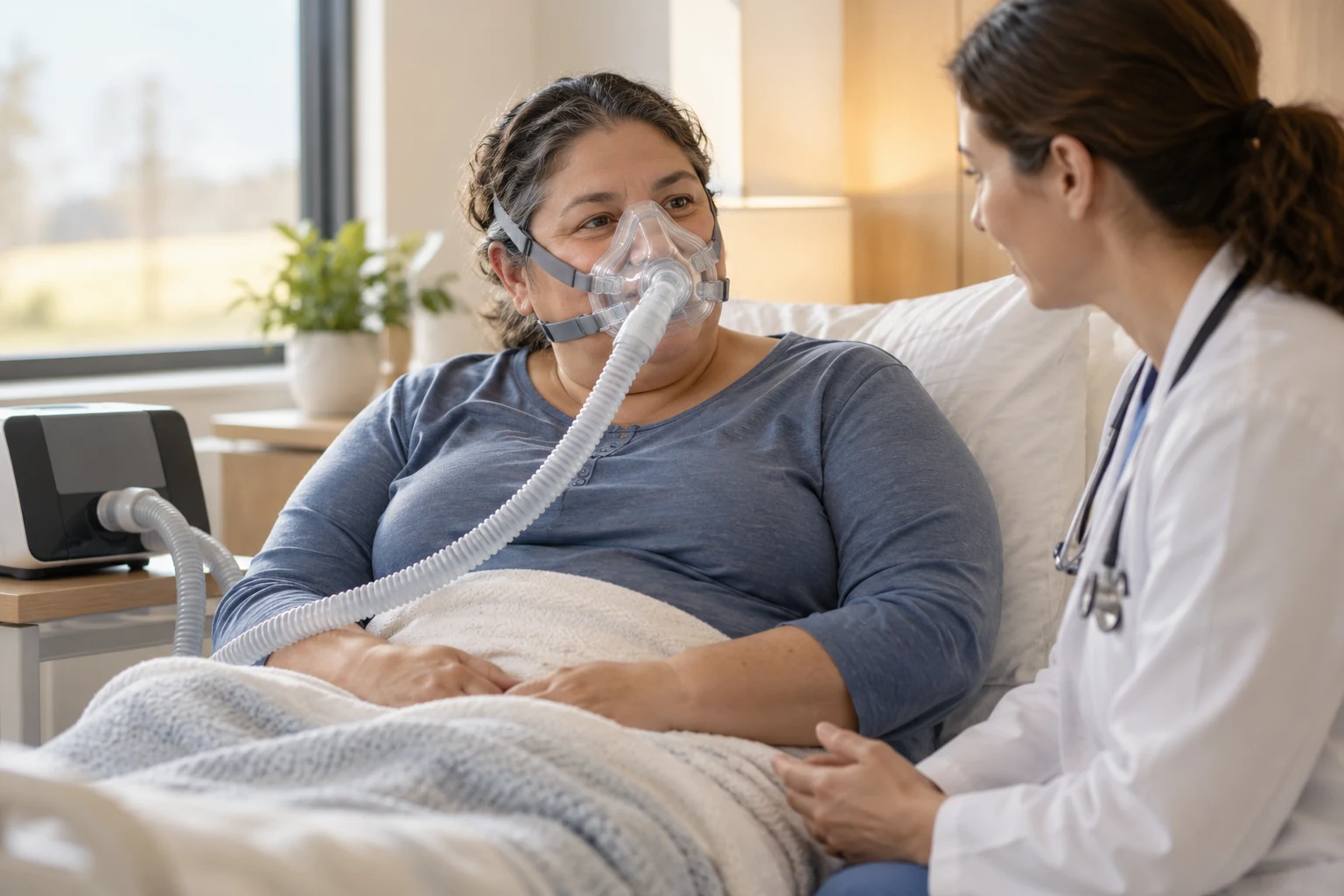
    Treat stable ambulatory patients diagnosed with OHS with positive airway pressure (PAP) therapy during sleep.
  • 4
    Start with CPAP therapy rather than NIV for stable OHS patients who have concomitant severe obstructive sleep apnea (AHI > 30 events/h).
  • 5
    Discharge hospitalized patients suspected of having OHS on noninvasive ventilation (NIV) until outpatient sleep studies and PAP titrations can occur.
  • 6
    Utilize bariatric interventions aiming for a 25-30% sustained weight loss to achieve resolution of OHS.

What's New in This Version

This version of the article was updated on November 15, 2019, with corrections listed in a published erratum (Am J Respir Crit Care Med 2019;200:1325–1326; DOI: 10.1164/rccm.v200erratum7).

Key Recommendations

Question 1

  • 1A

    For obese patients with sleep-disordered breathing with a high pretest probability of having OHS, we suggest measuring PaCO2 rather than serum bicarbonate or SpO2 to diagnose OHS.

    conditionalEvidence: very lowDiagnosis
  • 1B

    For patients with low to moderate probability of having OHS (<20%), we suggest using serum bicarbonate level to decide when to measure PaCO2: in patients with serum bicarbonate <27 mmol/L, clinicians might forego measuring PaCO2, as the diagnosis of OHS in them is very unlikely; in patients with serum bicarbonate >27 mmol/L, clinicians might need to measure PaCO2 to confirm or rule out the diagnosis of OHS.

    conditionalEvidence: very lowScreening
  • 1C

    We suggest that clinicians avoid using SpO2 during wakefulness to decide when to measure PaCO2 in patients suspected of having OHS until more data about the usefulness of SpO2 in this context become available.

    conditionalEvidence: very lowScreening

Question 2

  • 2

    For stable ambulatory patients diagnosed with OHS, we suggest treatment with PAP during sleep.

    conditionalEvidence: very lowTreatment

Question 3

  • 3

    For stable ambulatory patients diagnosed with OHS and concomitant severe OSA (apnea–hypopnea index > 30 events/h), we suggest initiating first-line treatment with CPAP therapy rather than NIV.

    conditionalEvidence: very lowTreatment

Question 4

  • 4

    We suggest that hospitalized patients with respiratory failure suspected of having OHS be started on NIV therapy before being discharged from the hospital, until they undergo outpatient workup and titration of PAP therapy in the sleep laboratory, ideally within the first 3 mo after hospital discharge.

    conditionalEvidence: very lowManagement

Question 5

  • 5

    For patients with OHS, we suggest using weight-loss interventions that produce sustained weight loss of 25–30% of actual body weight. This level of weight loss is most likely required to achieve resolution of hypoventilation.

    conditionalEvidence: very lowTreatment

Scope & Objectives

Clinical Topic

Obesity Hypoventilation Syndrome

Objectives

To optimize evaluation and management of patients with obesity hypoventilation syndrome (OHS).

Target Patient Population

Obese adults and patients with sleep-disordered breathing suspected of or diagnosed with OHS.

Diagnostic Criteria

Obesity (BMI > 30 kg/m2), sleep-disordered breathing (SDB), and awake daytime hypercapnia (awake resting PaCO2 > 45 mm Hg at sea level), after excluding other causes for hypoventilation.

Target Providers

pulmonologistsintensivistsemergency medicine specialistssleep medicine specialistsrespiratory therapistssleep technologistsprimary care physicianshospitalistsobesity specialistsbariatric surgeonsnursing home personnel

Patient Criteria & Setting

Therapeutic Area

Respiratory and Sleep Disorders

Guideline Scope

ScreeningDiagnosisManagement

Care Settings

Ambulatory CareHospitalSleep Centers

Special Populations

Severely obese patientsHospitalized patients with acute-on-chronic hypercapnic respiratory failure

Evidence Grading

System: GRADE

Evidence Distribution

0strong_recommendations
5very_low_quality_evidence
5conditional_recommendations

Evidence Levels

lowLow confidence in the estimated effects.
highHigh confidence in the estimated effects.
moderateModerate confidence in the estimated effects.
very_lowVery low confidence in the estimated effects.

Recommendation Strength

strongMost individuals in this situation would want the recommended course of action, and only a small proportion would not. Adherence to this recommendation could be used as a quality criterion or performance indicator.
conditionalMost individuals in this situation would want the suggested course of action, but many would not. Clinicians must help each patient arrive at a management decision consistent with her or his values and preferences.

Safety & Contraindications

Monitoring Guidance

Overnight monitoring should include continuous oximetry. Provide early (4-8 wk) follow-up to assess clinical/physiological response to PAP and monitor objective adherence to therapy.

Authors & Contributors

Babak MokhlesiJuan Fernando MasaJan L. BrozekIndira GurubhagavatulaPatrick B. MurphyAmanda J. PiperAiman TulaimatMajid AfsharJay S. BalachandranRaed A. DweikRonald R. GrunsteinNicholas HartRoop KawGeraldo Lorenzi-FilhoSushmita PamidiBhakti K. PatelSusheel P. PatilJean Louis PépinIsraa SoghierMaximiliano Tamae Kakazuand Mihaela Teodorescu

Guideline Features

Flowcharts includedBased on systematic reviewMultidisciplinaryPatient involvement

Learning Context

Difficulty

advanced

Learning Paths

Obesity Hypoventilation SyndromeSleep-Disordered BreathingHypercapniaPositive Airway Pressure (PAP)Noninvasive Ventilation (NIV)Continuous Positive Airway Pressure (CPAP)Bariatric SurgeryArterial Blood Gas Analysis