
Loading your page…
Loading your page…
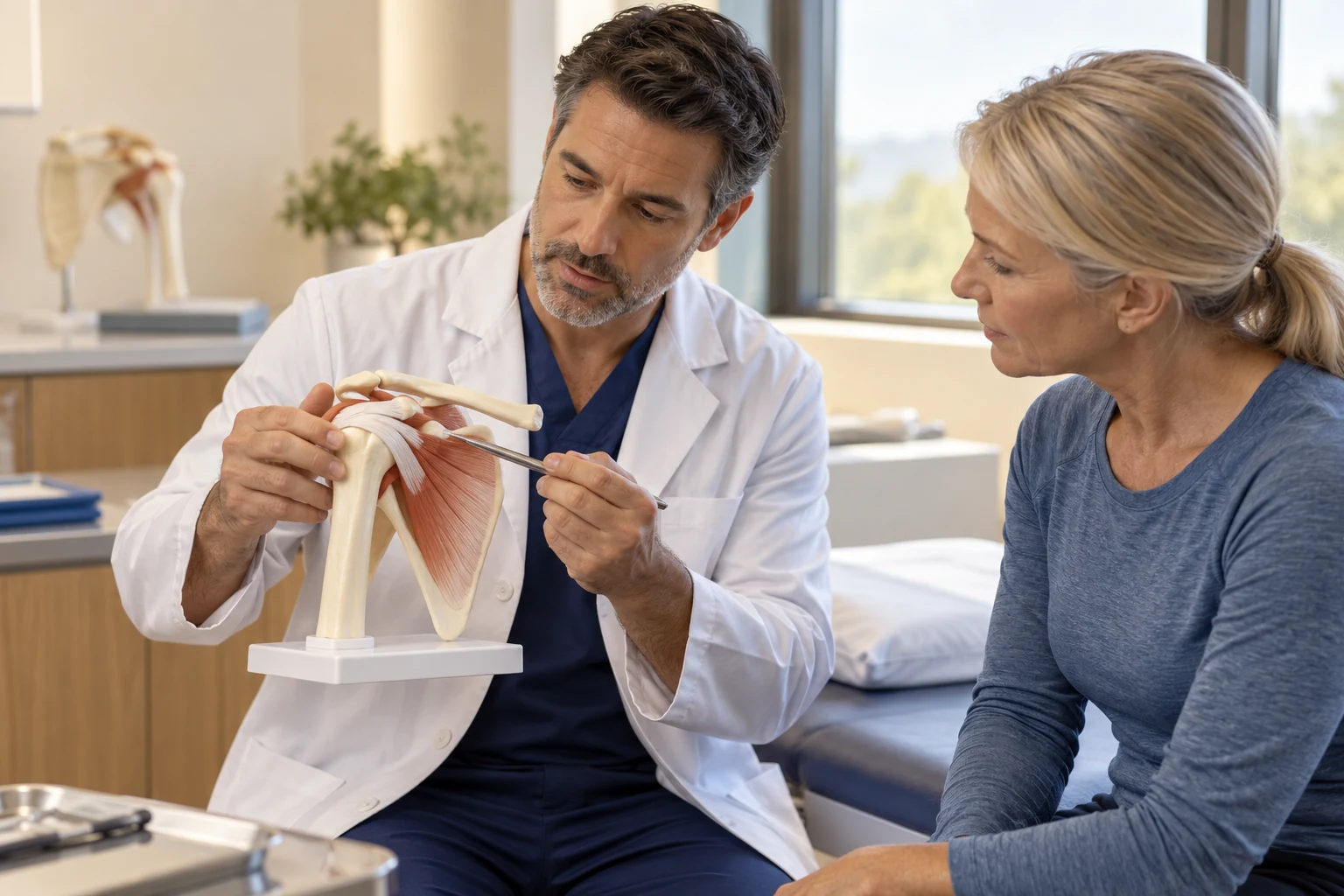
Published by American Academy of Orthopaedic Surgeons · GRADE Evidence to Decision Framework (EtDF)
Shoulder disease is a major cause of musculoskeletal disability in the United States, affecting approximately 8% of all American adults. Rotator cuff pathology is the leading cause of shoulder-related disability seen by orthopaedic surgeons, with surgical volume and associated costs on the rise.
Key Takeaways
Both physical therapy and operative treatment result in significant improvement in patient-reported outcomes for patients with symptomatic small to medium full-thickness rotator cuff tears.
Patient-reported outcomes (PROs) improve with physical therapy in symptomatic patients with full-thickness rotator cuff tears. However, the rotator cuff tear size, muscle atrophy, and fatty infiltration may progress over 5 to 10 years with non-operative management.
Healed rotator cuff repairs show improved patient-reported and functional outcomes compared to physical therapy and unhealed rotator cuff repairs.
The routine use of acromioplasty as a concomitant treatment is not suggested for therapeutic benefit as compared to arthroscopic repair alone for patients with small to medium sized full-thickness rotator cuff tears.
Clinical examination can be useful to diagnose or stratify patients with rotator cuff tears; however, a combination of tests will increase diagnostic accuracy compared to any single clinical examination test.
MRI, MRA, CT and ultrasound are useful adjuncts to a clinical exam and radiographs for identifying rotator cuff tears.
Postoperative clinical and patient-reported outcomes are similar for small to medium-sized full-thickness rotator cuff tears managed with early mobilization or delayed mobilization (delayed up to 8 weeks) for patients who have undergone arthroscopic rotator cuff repair.
Following arthroscopic rotator cuff repair, in certain patient populations, outcomes are not adversely affected with immediate weaning of sling use to allow active ROM for ADLs compared to prolonged sling use because similar post-operative healing, functional outcomes, and patient-reported outcomes are achieved.
Visits of physical therapy for supervision of exercises that are performed independently at home do not provide greater improvements in pain and function outcomes (at 3 months, up to 1 year) compared to a single session of physical therapist instruction followed by an independent home program in patients following arthroscopic rotator cuff repair for small tears.
The use of a single injection of corticosteroids with local anesthetic can be considered for short-term improvement in both pain and function for patients with shoulder pain. In patients who cannot tolerate corticosteroids, injectable NSAIDs may be considered.
Prolotherapy is not recommended for use in patients with full-thickness rotator cuff tears.
Conversion to full-thickness or transtendinous/in-situ repair can be performed in patients that failed conservative management with high-grade partial-thickness rotator cuff tears.
Debridement or repair of high-grade partial-thickness cuff tears that have failed physical therapy can be performed; however, repair of high-grade partial tears can improve outcomes.
Biological augmentation of rotator cuff repair with platelet-derived products is not recommended for improving patient-reported outcomes; however, limited evidence supports the use of liquid platelet rich plasma (PRP) in the context of decreasing retear rates.
Double row rotator cuff repair constructs are not recommended for improving patient-reported outcomes compared to single row repair constructs.
Double row repairs can result in lower overall retear rates after primary repair and improved patient-reported outcomes in large (>3cm) repairs. However, when evaluating for only full-thickness retears, double row repairs are not significantly favored.
Marrow stimulation at the time of rotator cuff repair does not improve patient-reported outcomes; however, this technique may decrease retear rates in patients with larger tear sizes.
The use of human dermal allografts to augment rotator cuff repair can lead to lower retear rates and better patient-reported outcomes, but porcine allograft is not suggested for use in rotator cuff augmentation.
The use of bioinductive tendon implants to augment rotator cuff repair or as an alternative to non-augmented repair can lead to lower retear rates and better patient-reported outcomes.
Evidence shows no difference in long-term (> 1 year) patient-reported outcomes or cuff healing rates between open and arthroscopic repairs; however, arthroscopic-only technique is associated with better short-term improvement in post operative recovery of motion and decreased visual analog scale (VAS) scores.
Multimodal analgesia programs or non-opioid individual modalities can be considered to provide added benefit for postoperative pain management following rotator cuff repair.
The use of hyaluronic acid injections may be considered in the non-operative management of rotator cuff pathology with no tears.
The routine use of platelet rich plasma is not supported for the treatment of rotator cuff tendinopathy or partial tears.
Multiple steroid injections may compromise the integrity of the rotator cuff, which may affect attempts at subsequent repair.
Evidence suggests that the routine use of PRP in the non-operative management of full-thickness rotator cuff tears may not be indicated.
In the absence of reliable evidence, it is the opinion of the workgroup that physical therapy, biceps tenotomy/tenodesis, partial repair, tendon transfer, superior capsular reconstruction, arthroscopic debridement, balloon spacers, graft interposition, or graft augmentation (non-porcine) can improve patient-reported outcomes.
In the absence of reliable evidence, it is the opinion of the workgroup that in patients with massive, unrepairable tears and significant functional loss who have failed other treatments, reverse arthroplasty can improve patient-reported outcomes.
In the absence of reliable evidence, it is the opinion of the workgroup that after failure of conservative treatment, reverse shoulder arthroplasty for massive unrepairable tears with glenohumeral joint arthritis can improve patient-reported outcomes.
In the absence of reliable evidence, it is the opinion of the workgroup that physical therapy can improve outcomes in patients with low-grade or intermediate-grade partial-thickness rotator cuff tears. In patients with persistent pain and functional impairment after appropriate non-operative treatment, surgery can improve outcomes.
Clinical Topic
Management of Rotator Cuff Injuries
Objectives
To help improve treatment based on the current best evidence for the management of rotator cuff injuries.
Target Patient Population
Adults with rotator cuff injuries
Diagnostic Criteria
Clinical examination (utilizing tests such as Bear Hug, Belly Press, Empty Can, etc.) combined with imaging adjuncts (MRI, MRA, CT, ultrasound) are useful to diagnose and identify rotator cuff tears.
Target Providers
Therapeutic Area
Musculoskeletal DiseaseGuideline Scope
Inclusion Criteria
Exclusion Criteria
Care Settings
System: GRADE Evidence to Decision Framework (EtDF)
Evidence Levels
Recommendation Strength
Contraindications
Monitoring Guidance
Surveillance with serial clinical evaluation and imaging for patients treated non-operatively following a rotator cuff tear may be considered if surgical repair remains a viable option.
Difficulty
advanced
Exam Relevance
Learning Paths