Hépato-gastro-entérologie
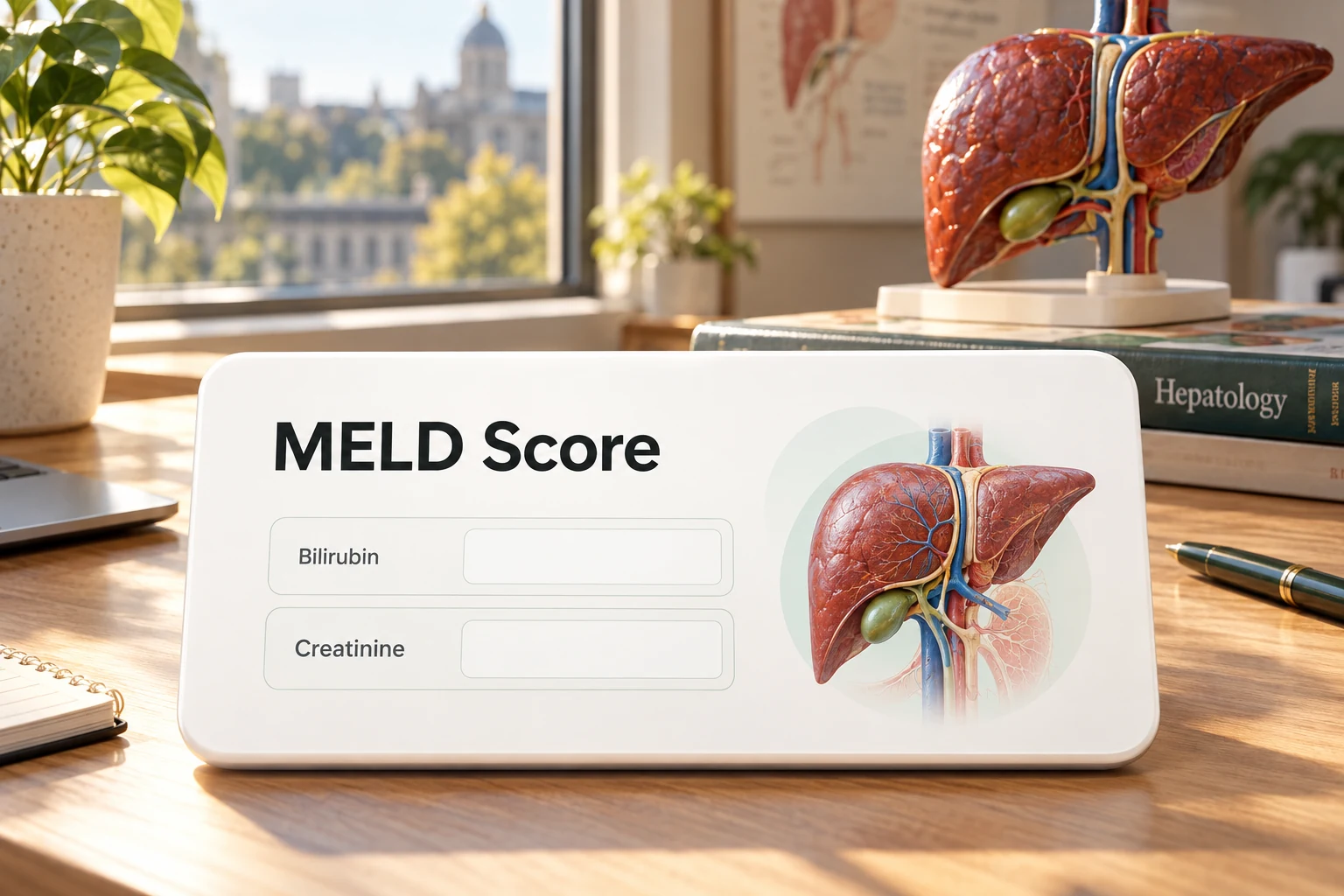
Model for End-Stage Liver Disease Score
Priorité de transplantation hépatique — MELD ajusté sur la natrémie.
Contenu en anglais
Calculateur Score MELD-Na
Résultat
6points
Priorité faible — mortalité à 90 jours ~2%
Comment l’utiliser
- 1
Biologie dans les 24h précédant l’inscription. L’UNOS plafonne la créatinine à 4.0 mg/dL et compte 2+ séances de dialyse par semaine comme 4.0.
- 2
La plage de Na 125–137 compte. Natrémie < 125 : utiliser 125. > 137 : utiliser 137 (sans effet).
- 3
Formule du MELD-Na. MELD-Na = MELD + 1.32(137−Na) − 0.033×MELD×(137−Na).
Quand l’utiliser
Use in adults with known or suspected chronic liver disease, cirrhosis, or acute liver failure to estimate prognosis and prioritise liver transplantation. Also guides intensity of monitoring and ICU admission decisions.
- Attribution des greffons hépatiques
- L’UNOS utilise un MELD-Na ≥15 pour les propositions de greffons de donneur décédé (priorité sur le donneur vivant).
- Pronostic de la cirrhose
- MELD-Na < 10 : prise en charge médicale. 10–14 : surveillance. ≥15 : discussion d’inscription.
- Évaluation avant TIPS
- MELD > 18 après TIPS : survie médiocre. Discuter soins palliatifs vs transplantation.
À propos du score
The Model for End-Stage Liver Disease (MELD) score is a validated prognostic scoring system for patients with chronic liver disease, liver cirrhosis, and acute liver failure. Originally developed to predict 90-day mortality following elective TIPS (transjugular intrahepatic portosystemic shunt) procedures, it became the primary tool for organ allocation in liver transplantation in the United States (UNOS/OPTN) from 2002 and is now used by European transplant networks. MELD uses three objective laboratory values — INR, serum bilirubin, and serum creatinine — to generate a score predicting short-term mortality risk. MELD-Na (incorporating serum sodium) has improved predictive accuracy and is now preferred by many centres.
Questions fréquentes
What is a high MELD score?
A MELD score ≥20 indicates substantial liver disease severity with 90-day mortality risk of 20–30%. Scores ≥30 carry >50% 90-day mortality and typically require urgent liver transplant evaluation. Scores ≥40 are associated with >70% short-term mortality without transplantation.
What is the difference between MELD and Child-Pugh score?
MELD uses three objective laboratory values (INR, bilirubin, creatinine) and is the current standard for transplant prioritisation. Child-Pugh includes two subjective components (ascites severity and encephalopathy grade), making it less reproducible. MELD has replaced Child-Pugh for transplant allocation but Child-Pugh remains useful for assessing surgical risk and cirrhosis staging.