
Loading your page…
Loading your page…
Quick Sequential Organ Failure Assessment
Rapidly screen for sepsis at the bedside using three clinical criteria. qSOFA identifies deteriorating patients outside the ICU who may need urgent intervention.
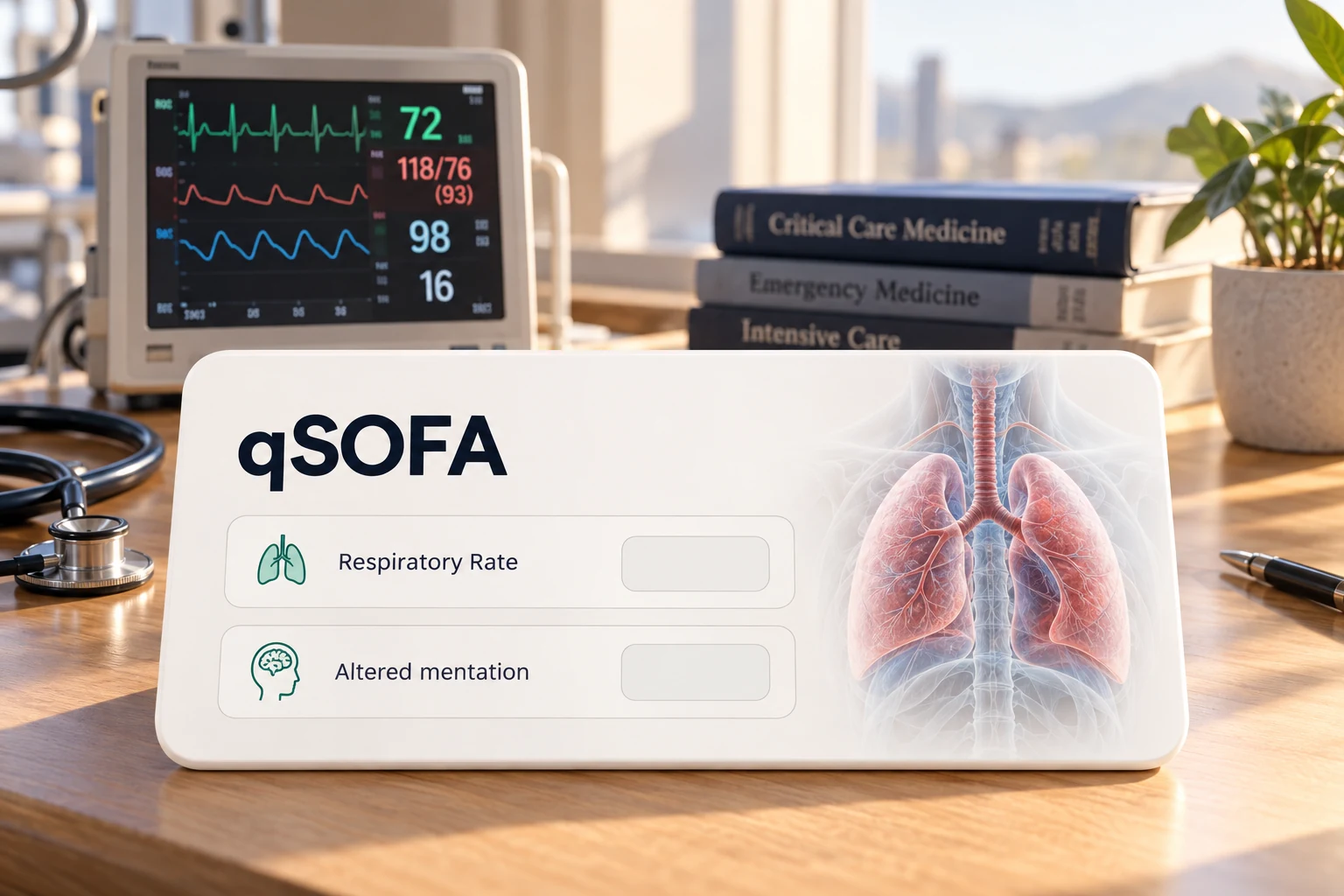
The quick SOFA (qSOFA) score is a rapid, three-criterion bedside tool introduced with the Sepsis-3 consensus definitions in 2016. It was designed to identify patients outside the ICU — in emergency departments, general wards, or primary care settings — who may have sepsis and are at risk of poor outcomes. Unlike the full SOFA score, qSOFA requires no laboratory tests, making it immediately applicable in any clinical setting. A positive qSOFA (≥2 of 3 criteria) should prompt clinical reassessment, consideration of sepsis, and escalation of care — including measurement of lactate and blood cultures.
Use as a bedside screening tool in any patient with suspected infection outside the ICU, particularly in emergency departments and general wards. Positive qSOFA should trigger full SOFA assessment, blood cultures, lactate measurement, and urgent clinical review.
qSOFA — Variables & Points
Respiratory rate ≥ 22 breaths/min
Altered mentation (GCS < 15)
Systolic blood pressure ≤ 100 mmHg
qSOFA negative
Sepsis less likely — continue assessment if clinically concerned
qSOFA positive
Suspect sepsis — escalate care, measure lactate, blood cultures, full SOFA
Sepsis-3 (JAMA 2016): qSOFA ≥2 outside the ICU should prompt clinicians to investigate for organ dysfunction. It does not replace full SOFA for the sepsis diagnosis but serves as a rapid bedside prompt for clinical concern.
qSOFA is a screen, not a diagnostic test — a score of 0–1 does not exclude sepsis if clinical suspicion is high.
Many guidelines now use NEWS2 (National Early Warning Score 2) alongside qSOFA on general wards — both are complementary.
If qSOFA ≥2, act immediately: blood cultures, IV access, lactate, broad-spectrum antibiotics within 1 hour of sepsis recognition.
Altered mentation is a powerful predictor — any acute change in GCS, confusion, or agitation in an infected patient should raise concern.
Lower sensitivity than SIRS criteria for identifying sepsis — will miss some cases.
Not validated in immunocompromised patients, where the inflammatory response may be blunted.
Should not replace clinical judgement in patients with known chronic disease affecting the criteria (e.g., COPD with chronic tachypnoea).
Create a free Prognia account to use the qSOFA calculator — including auto-scored results, interpretation, and CPD logging.
Free plan · No credit card · Instant access
A qSOFA score of ≥2 out of 3 is considered positive and indicates that sepsis should be suspected. This should prompt immediate escalation: blood cultures, lactate measurement, IV access, and consideration of broad-spectrum antibiotics within the 1-hour sepsis bundle.
SIRS (Systemic Inflammatory Response Syndrome) criteria were used in Sepsis-1 and Sepsis-2 definitions and included temperature, heart rate, respiratory rate, and white blood cell count. They were replaced by SOFA/qSOFA in Sepsis-3 (2016) because SIRS lacked specificity and could be met by non-infectious conditions. qSOFA focuses on clinical signs of organ dysfunction rather than the inflammatory response.