
Loading your page…
Loading your page…
Congestive heart failure, Hypertension, Age ≥75, Diabetes, Stroke/TIA, Vascular disease, Age 65–74, Sex category
Calculate stroke risk in non-valvular atrial fibrillation. CHA₂DS₂-VASc score guides anticoagulation decisions per ESC 2020 and AHA guidelines.
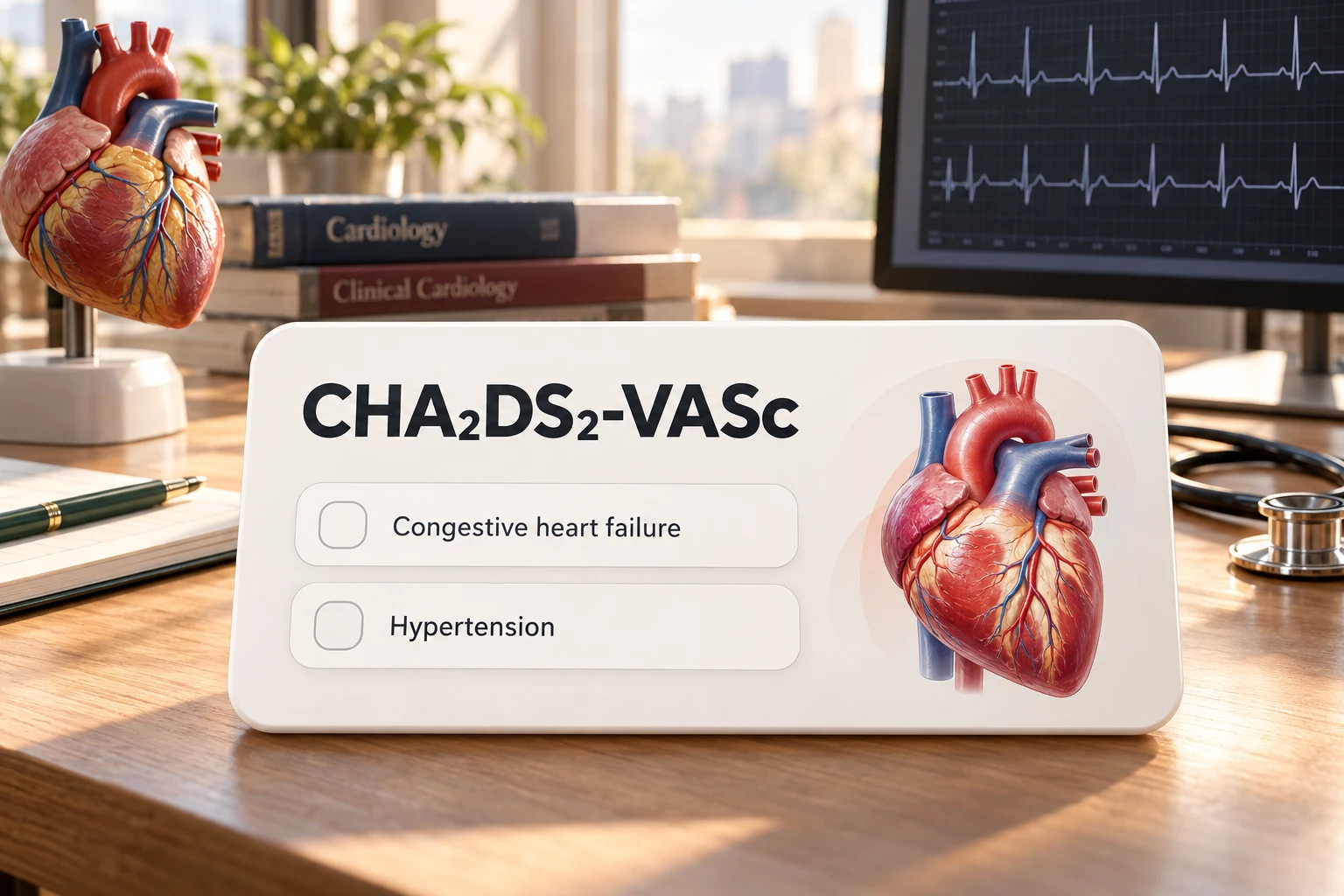
The CHA₂DS₂-VASc score is the internationally validated tool for estimating annual stroke risk in patients with non-valvular atrial fibrillation (AF). It replaced the older CHADS₂ score due to superior ability to identify truly low-risk patients who do not need anticoagulation. The score assigns weighted points to eight clinical risk factors, producing a total from 0 to 9. It is the primary decision tool cited in the ESC 2020 AF Guidelines, the AHA/ACC AF guidelines, and NICE guidance on AF management.
Use in all patients diagnosed with non-valvular atrial fibrillation (paroxysmal, persistent, or permanent) to determine the need for long-term oral anticoagulation. Also applicable in atrial flutter. Not validated for valvular AF (rheumatic mitral stenosis or mechanical heart valves), where anticoagulation is always indicated.
CHA₂DS₂-VASc — Variables & Points
Congestive heart failure / LV dysfunction
Symptomatic HF or objective evidence of reduced LVEF
Hypertension
Resting BP >140/90 mmHg on ≥2 occasions or on antihypertensive therapy
Age ≥ 75 years
Double-weighted risk factor
Diabetes mellitus
Fasting glucose >125 mg/dL or on oral hypoglycaemic / insulin therapy
Stroke / TIA / Thromboembolism (prior)
Double-weighted risk factor — strongest individual predictor
Vascular disease
Prior MI, peripheral artery disease, or aortic plaque
Age 65–74 years
Separate from the ≥75 category
Sex category (female)
Only a risk modifier — does not add risk when it is the sole risk factor
Low risk
No antithrombotic therapy recommended
Intermediate risk
Consider anticoagulation based on clinical context
High risk
Oral anticoagulation recommended (NOAC preferred)
ESC 2020 AF Guidelines (Class I, Level A): Oral anticoagulation is recommended in all patients with a CHA₂DS₂-VASc score ≥2 (men) or ≥3 (women). NOACs are preferred over vitamin K antagonists in eligible patients. Female sex alone (score = 1) does not warrant anticoagulation.
Female sex is a risk modifier, not an independent risk factor — a woman with a score of 1 (sex only) is low risk and does not need anticoagulation.
Prior stroke/TIA carries the highest individual weight (2 points) and alone indicates anticoagulation regardless of other factors.
NOACs (apixaban, rivaroxaban, dabigatran, edoxaban) are preferred over warfarin for non-valvular AF in most patients.
Re-calculate annually or after any change in risk factors — patients can move from low to high risk over time.
Always assess bleeding risk with HAS-BLED score alongside CHA₂DS₂-VASc — a high HAS-BLED score prompts correction of modifiable bleeding risks, not withholding anticoagulation.
Validated for non-valvular AF only — not applicable to rheumatic mitral stenosis or mechanical heart valves.
Does not account for renal function, which affects NOAC dosing choice.
Less discriminating in patients with very low scores; clinical context always applies.
Create a free Prognia account to use the CHA₂DS₂-VASc calculator — including auto-scored results, interpretation, and CPD logging.
Free plan · No credit card · Instant access
A score of 0 in males (or 1 in females, from sex alone) is considered low risk. No anticoagulation is recommended at this level. Scores ≥2 in males or ≥3 in females indicate high stroke risk requiring oral anticoagulation.
ESC 2020 and AHA guidelines recommend NOACs (non-vitamin K oral anticoagulants) as first-line therapy over warfarin for patients with non-valvular AF and a high CHA₂DS₂-VASc score, unless there are contraindications such as severe renal impairment or mechanical heart valves.
Reassess at least annually and after any clinical change — new heart failure diagnosis, new stroke or TIA, new diabetes, or a birthday crossing a 65 or 75 age threshold can all change the score and the anticoagulation decision.
CHA₂DS₂-VASc has replaced CHADS₂ in all major guidelines (ESC, AHA/ACC, NICE) because it better identifies truly low-risk patients and includes additional clinically relevant variables. CHADS₂ is no longer recommended for clinical decision-making.